
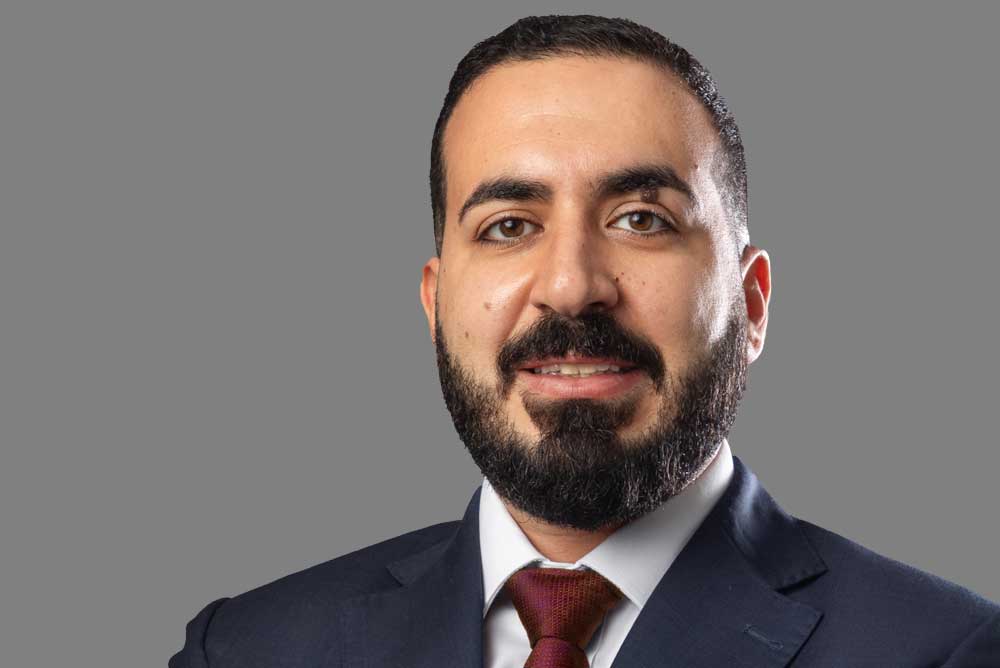
Read Full Magazine Here. In an era defined by volatility and transformation, few voices resonate with the clarity and conviction of Michel Nassar.
From his formative years as an honor student at the New York Institute of Technology to his current role as Managing Partner – Engineering, Energy & Power at Cope, Nassar has built a career on discipline, foresight, and an unyielding commitment to excellence.
With over fourteen years of experience spanning underwriting, broking, negotiation, and reinsurance, he has become a trusted authority in engineering and energy insurance—bridging the worlds of oil and gas, renewable energy, and complex engineering risks. At Cope, the Cyprus based investment group founded in 2023, Nassar leads a division that is not only expanding across MENA and the GCC but also strategically positioning itself in Europe, Africa and Asia emerging as a key growth frontier.
Opening Note: In a world where energy security and engineering resilience have become the cornerstones of economic survival, Michel Nassar stands at the intersection of expertise and vision. His blueprint for 2026 reflects both pragmatism and ambition, offering a roadmap for resilience that balances regional volatility with opportunity, and positions engineering as a driver of sustainable futures.
Nassar shares his vision for navigating 2026: balancing regional volatility with opportunity, aligning engineering with sustainability, and preparing the next generation of professionals to thrive in a rapidly shifting energy landscape. His insights reveal not just a roadmap for resilience, but a philosophy of leadership that transcends uncertainty.
BUSINESS LIFE sat down with the reputed Michel Nassar and conversed in-depth insights into the future of engineering and energy insurance.
In a candid conversation, he outlined how Cope Re is navigating regional volatility while unlocking opportunities in new markets. His insights reveal a resilient approach—one that blends technical precision with strategic foresight, offering a blueprint for growth in an era defined by uncertainty and transformation.
His strategies for navigating 2026, especially in balancing regional volatility with emerging opportunities, provide a clear picture of Cope Re’s resilient approach.
Strategic Energy & Engineering Trends
BL: What are the most pressing challenges in integrating renewable energy into legacy power infrastructures across MENA?
Michel Nassar: Renewable energy is firmly on the agenda across MENA and the GCC, and we are seeing a clear increase in new projects coming to market. However, the pace of integration remains measured compared to other regions, largely because low-cost hydrocarbon generation still provides a strong economic baseline.
The core challenge is execution—integrating renewables into legacy grids requires significant investment in infrastructure, storage, and system flexibility, all while managing higher technical complexity and evolving risk profiles.
The opportunity going forward is in structuring solutions that make renewable integration commercially viable within the region’s existing energy framework.
BL: How is the role of the engineer evolving as corporations embrace sustainability and decarbonization targets?
Michel Nassar: The engineer is no longer purely technical—they are now a strategic driver of business outcomes. Their role has shifted from execution to optimizing performance, reducing emissions, and ensuring projects are commercially viable. This includes managing renewable integration, hybrid systems, and new risk dynamics.
Today, engineers act as a bridge between engineering, finance, and risk, directly enabling corporations to deliver on decarbonization targets.
BL: In your view, how can engineering education embed climate change mitigation into technical training without losing rigor?
Michel Nassar: By integrating climate considerations directly into core engineering disciplines.
Rather than adding standalone sustainability modules, programs should embed emissions, efficiency, and lifecycle analysis into design, systems, and project engineering from the outset. The rigor remains intact, but the parameters evolve over time.
The focus should be on real-world problem solving, where students balance performance, cost, and carbon impact simultaneously.
This approach produces engineers who are not only technically strong, but also capable of delivering commercially viable, low-carbon solutions.
Compliance, Risk & Real-World Application
BL: Risk and compliance are central to your work. How do we teach engineers to anticipate and mitigate risks before they materialize?
Michel Nassar: By shifting mindset from reactive to proactive approach.
Engineers are being trained to identify risk at the design stage through scenario analysis, stress testing, and understanding failure modes - not after execution. Risk becomes a core design parameter, not a compliance exercise.
The goal is to build engineers who don’t just solve problems—but anticipate, quantify, and mitigate risk before it materializes.
BL: What strategies can firms adopt to remain compliant amid sweeping regulatory changes while still innovating?
Michel Nassar: Firms need a proactive, not reactive, compliance model. This starts with a vigilant, well-embedded compliance function that works alongside the business, not in isolation. Staying closely connected to regulators and actively participating in market forums is critical to anticipate changes early.
At the same time, innovation must be structured within clear governance frameworks—so new solutions are developed with compliance in mind from the outset, not retrofitted later.
The firms that perform best are those that treat compliance as a strategic enabler, not a constraint.
BL: Which critical skills do you find missing in new graduates entering the energy and engineering sectors today?
Michel Nassar: The key gap is the lack of real-world application.
Many graduates struggle to translate technical knowledge into practical, solution-driven outcomes. There is also weak engagement with finance, insurance, and management functions, which limits their ability to operate in complex project environments.
Bridging this gap is essential to develop engineers who can deliver integrated, commercially viable solutions.
Forward-Looking Leadership
BL: What is your vision for the region engineering and energy sector in 2026 and beyond, and how should firms position themselves?
Michel Nassar: We have positioned ourselves as a strong player in the facultative reinsurance market, delivering tailored solutions backed by deep technical understanding of the risks we place.
Looking ahead, MENA and the GCC will continue to see strong momentum in engineering projects, driven by new cities, infrastructure expansion, and strategic developments across the region.
The energy sector is expected to remain stable over the next five years, with consistent—if not increasing—production in key markets. Oil and gas demand remains resilient in the medium term, even as energy transition initiatives accelerate.
Firms should position themselves with technical depth, agility, and the ability to structure complex, multi-faceted risks, as the market increasingly rewards specialization over scale.
BL: What advice would you give professionals transitioning from traditional engineering roles into insurance and reinsurance market?
Michel Nassar: They need to invest time in understanding how the market truly operates—not just technically, but commercially.
This means building a solid foundation through dedicated insurance qualifications; while actively studying the risks they encounter in real projects. Day-to-day exposure to risk is the most valuable source of learning.
Success in this transition comes from combining engineering knowledge with risk interpretation, market awareness, and continuous learning.
2026 Strategy & Achievements at Cope Re
BL: What have been your top three strategic achievements at Cope Re in 2026 so far?
Michel Nassar: First, we successfully delivered on our Q1 2026 targets, maintaining strong growth momentum and reinforcing our position in the facultative reinsurance market.
Second, we strengthened our technical positioning by expanding our facilities, with increased capacities and a wider underwriting appetite aligned with our growth strategy. This has enabled us to deliver more tailored and complex solutions across engineering and energy risks.
Third, we enhanced our market presence and strategic relationships, supporting disciplined growth, strong governance, and selective expansion into new opportunities.
BL: What are your primary targets for energy, engineering and power insurance growth this year?
Michel Nassar: Our priority is to deliver sustainable growth across all lines of business while maintaining the high service standards our clients expect.
We are focused on expanding our portfolio in energy, engineering, and power, while strengthening long-term relationships across the market.
Growth is important—but it must be disciplined, supported by consistent execution, strong service delivery, and close alignment with our partners.
BL: How are you adapting underwriting strategies for complex infrastructure projects in the current climate?
Michel Nassar: Many markets are now exposed to climate-related risks that were not fully reflected in pricing over the past decade.
In response, we actively assess evolving climate exposures in the region and incorporate them into our underwriting approach—through updated conditions, clearer limitations, and more disciplined structuring for our reinsurers.
We operate with an underwriting mindset, ensuring the risks we place are well understood, accurately priced, and aligned with current and emerging realities.
Impact of MENA & GCC Conflicts
BL: How has regional volatility specifically impacted energy infrastructure risks and claims?
Michel Nassar: Regional volatility has primarily impacted project timelines, with some developments delayed or deferred due to uncertainty.
From an operational standpoint, energy production has remained broadly stable. However, the risk profile has increased—particularly around supply chain disruptions and delivery challenges, which can affect production volumes.
If these disruptions escalate, production levels will inevitably be impacted, as storage capacity is not a sustainable solution in most cases.
BL: How has Cope Re adjusted its risk appetite in the GCC?
Michel Nassar: In the current environment, we stay close to reinsurers, continuously tracking shifts in capacity, pricing, and risk tolerance across the GCC. This allows us to structure placements that reflect real market conditions, not outdated assumptions.
We focus on matching the right risks with the right markets, ensuring solutions remain viable, even as appetite becomes more selective.
In essence, we don’t ride the wave blindly—we read it, position accordingly, and deliver outcomes that work for both clients and markets.
Regional Economic Outlook
BL: How do you assess the stability of the engineering and energy markets for the remainder of 2026?
Michel Nassar: The market remains stable, supported by strong capacity and generally profitable portfolios.
At this stage, we do not expect any material shifts in market conditions. The fundamentals are intact, and activity across engineering and energy lines continues to progress at a steady pace.
For the remainder of 2026, we anticipate continued, measured growth, in line with current market dynamics.
Looking Forward (2026–2027)
BL: What emerging risks in the Energy, engineering and power sector concern you most, and how are you preparing for them?
Michel Nassar: One of the key concerns is the current soft market environment. If it persists, it may redirect investor focus into other sectors, potentially reducing available capacity and leading to market hardening over the next 3–5 years.
We are preparing by staying closely aligned with our reinsurers, and structuring placements that remain sustainable even if conditions tighten.
The focus is on anticipating shifts early and ensuring continuity of capacity for our clients, regardless of market cycles.
BL: How do you see artificial intelligence and digital transformation redefining risk management in your sector?
Michel Nassar: Digital transformation is already enhancing the market by enabling more comprehensive risk assessment and data-driven decision making.
AI, in particular, will play a central role—improving risk analysis, pricing accuracy, and the ability to model complex engineering exposures in real time. It allows the market to move from reactive assessment to more predictive risk management.
At the end of the day, this remains a relationship-driven market where experience and human judgement matter. AI will complement decision-making rather than replace it, with limited disruption to employment compared to other industries.
Overall, it is a clear shift toward more informed, faster, and more precise risk management frameworks.
Closing Note
Michel Nassar’s perspective is not merely technical—it is strategic, human, and forward looking. His ability to weave compliance, innovation, and education into a coherent vision for the energy sector underscores why he is regarded as one of the most influential voices in engineering and reinsurance today. As the region confronts turbulence and opportunity in equal measure, his blueprint for resilience offers a timely reminder: leadership is not about predicting the future, but about preparing for it.